
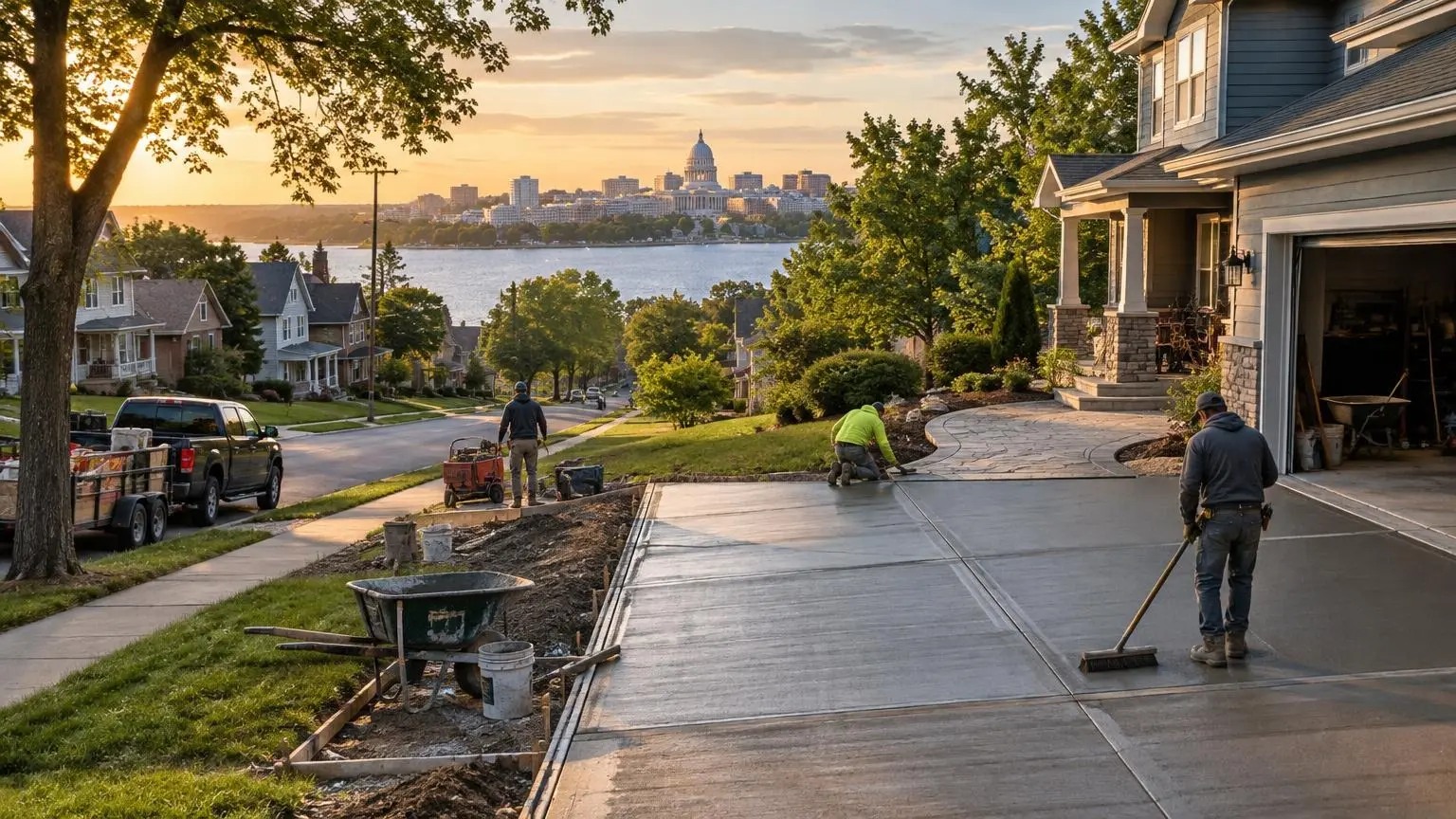
Flatwork for the isthmus and beyond
Concrete Contractors in Madison, WI
Driveways, patios, walks and steps poured for 50-inch snow years, plus lifting and resurfacing when a slab can be saved.
- Free on-site measuring and a written, itemized quote
- Repair, lifting and replacement priced side by side when each is an option
- Help sorting out city sidewalk notices and driveway approach permits
Concrete Built for Madison Winters
Elite Concrete Contractors Madison builds, replaces and repairs residential concrete in Madison, Wisconsin, from the bungalow blocks near the isthmus between Lake Mendota and Lake Monona out to the newer subdivisions on the far west and east sides. As concrete contractors in Madison, we plan every job around one fact: this is a hard place for outdoor concrete. Wikipedia's climate table for the city, based on Dane County Regional Airport normals from 1991 to 2020, puts the January average high at 27 degrees and the low at 11.8, with 51.8 inches of snow in an average year. A driveway or walk that survives decades here is one that was built for it.
What wears concrete out around Madison
Ice inside the surface. Concrete soaks up water. When that water freezes it expands, and after enough freeze-and-thaw cycles the top layer starts to flake off. That flaking is called scaling, and it is the most common complaint we hear in spring.
De-icers. Salt keeps the surface wet with brine and adds extra melt-and-refreeze cycles. Some de-icers made with ammonium compounds also attack the cement paste directly. Salt is a problem off the slab too: the City of Madison reports that chloride in Lake Wingra topped 100 mg/L in 2016, about ten times its early-1960s level, and that salt has reached 3 of the city's 22 drinking water wells.
Ground that moves. Soil that stays wet under a slab freezes and lifts in winter, then softens in spring. Panels drop, tip toward the house or crack into pieces.
Our standard response to all three:
- Air-entrained concrete on every exterior pour, so ice has room to expand
- A compacted stone base that lets water drain out from under the slab
- Thickness matched to the load, about 4 inches for walks and patios and more where trucks park
- Joints laid out on purpose, so shrinkage cracks follow straight lines
- No salt on new concrete during its first winter
Old blocks, postwar ranches and new subdivisions
Point2Homes, summarizing Census survey data, gives 1980 as the median year built for Madison's 133,530 housing units. The spread around that number is wide. About 13 percent of homes were built in 1939 or earlier, roughly a third went up between 1950 and 1979, and about 27 percent date from 2000 through 2019. Wikipedia lists the Marquette Bungalows and Orton Park historic districts on the east side, and the city counts more than 120 neighborhood associations.
Each era brings different concrete. On prewar blocks, front stoops, walks and narrow drives often predate modern air-entrained mixes and have settled or pulled away from the house. Postwar ranches tend to have original driveways and patios that have been patched more than once. In 2000s subdivisions, first-generation driveways are now 20 years or more into Wisconsin winters, the age when aprons crack and panels near the garage start to sink.
The parts of your frontage the city controls
In Madison, the concrete in front of a house is split between owner and city. The Engineering Division runs an Annual Sidewalk Repair and Rehabilitation Program. Inspectors mark public sidewalk that is broken, offset, settled or ponding with a white paint "X." Slabs with a pink mark and a white "c" can be sawcut to taper a small offset at no cost to the owner, and owners may not grind them down themselves.
The city's program brochure gives owners two choices. Under Option One you hire your own contractor licensed by the Board of Public Works, get a Street Terrace Permit, call the Sidewalk Office at 266-4537 within 20 days of the notice, and pay that contractor directly. Under Option Two the city's contractor does the work and you pay one-half of the repair cost through a special assessment, with driveway restoration billed at full cost. The bill can be paid without interest by October 31 or spread over the city's five-year installment plan.
Driveway approaches are a separate permit. The city's driveway standards treat a home with four or fewer parking stalls and a raised curb as a Class I approach, permitted by the City Engineer, with an entrance no wider than 20 feet and a curb cut no wider than 30 feet. Moving or widening an entrance takes written permission. When a project touches the public side, our quote marks where your slab ends so you know what needs a permit before work is scheduled.
What we pour and fix
- Driveways: tear-out and replacement, widening, new aprons and parking pads.
- Patios: broom-finished, colored or exposed-aggregate slabs, with steps and paths to the yard.
- Stamped concrete: stone, slate and brick patterns for patios, walks and driveway borders.
- Sidewalks and steps: front walks, side paths, stoops and poured steps with landings.
- Leveling and lifting: mudjacking or foam to raise sunken panels on sound slabs.
- Repair and resurfacing: crack sealing, overlays on flaking surfaces and spot replacement of failed panels.
How a project runs
Measuring visit. We walk the area, measure, and note what affects price: how much has to come out, slope and drainage, tree roots and how close the ready-mix truck can get.
Written quote. Itemized, and with a repair option priced alongside replacement where one exists.
Prep. Removal, digging out soft soil, compacting a stone base and setting forms to the right grade.
Pour. Reinforcement where the slab needs it, then placing, finishing and jointing.
Handoff. Written dates for foot traffic, cars and sealing. HomeGuide's driveway guide says to wait at least 7 days before driving on new concrete and the full 30 days for heavy vehicles.
Planning around the season
Most exterior concrete in Dane County is poured between the spring thaw and the first hard freeze. Concrete that freezes before it gains strength can be ruined, so a late-fall pour needs nights above freezing in the forecast and sometimes insulated blankets. A slab poured late in the year also faces its first winter almost immediately. The city's own advice for new sidewalk is to avoid salt that first winter; Madison also notes that salt does not work well below 15 degrees and offers free sand at several city locations. If you call in October or November, we will tell you honestly whether to pour now or book for spring. Call (608) 597-6094 to set up a visit.
Why Homeowners Call Elite Concrete Contractors Madison
Built for Dane County winters
Air-entrained mix, a drained stone base and planned joints on every exterior slab.
Quotes you can compare
Removal, base, thickness, steel, finish and sealing priced line by line.
Lifting and repair when they work
We price mudjacking, foam lifting or resurfacing next to replacement when the slab is still sound.
City sidewalk notices explained
We walk through Madison's Option One and Option Two choices and the driveway approach rules before you decide.
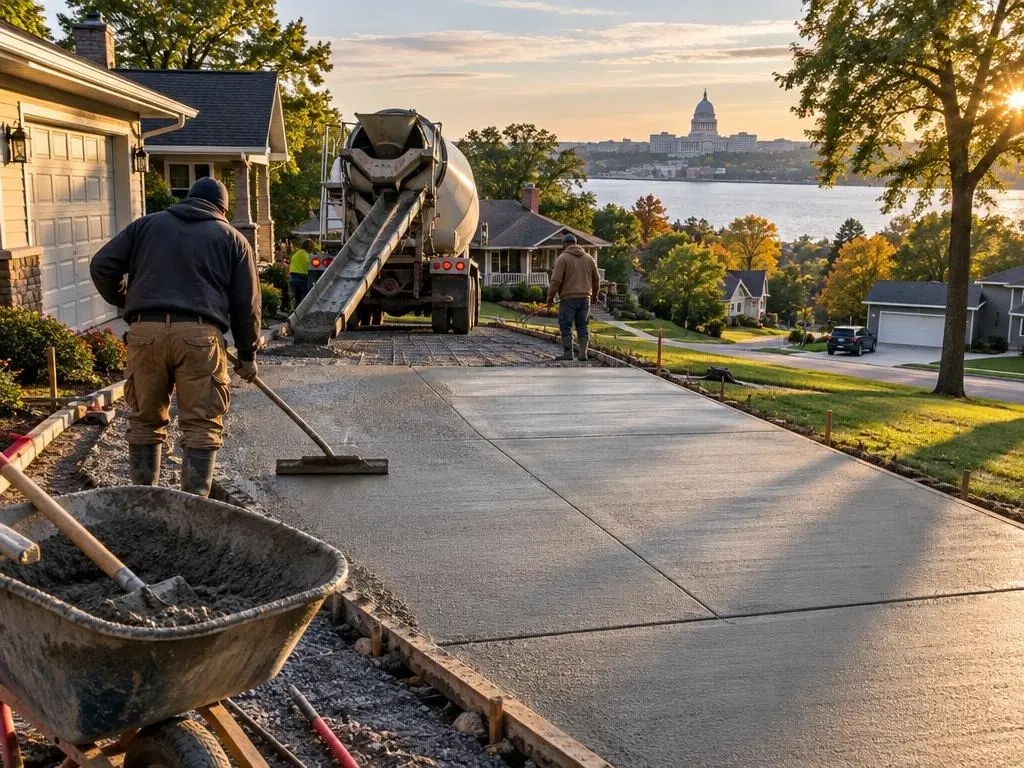
Common Questions
How do I compare residential concrete contractors in Madison?
Get two or three written bids and compare what is in them, not just the total. Each should state slab thickness, base depth, air-entrained concrete, reinforcement, joint layout and who handles permits. If the work reaches the public sidewalk or the driveway approach, ask how the bidder handles the city side. A contractor who can tell you why your old slab failed is better placed to keep the new one from doing the same.
Do small concrete jobs make sense to call about?
Yes. A single stoop, a few sidewalk squares, a sunken patio panel or a pad for a grill or shed are all normal requests. HomeGuide notes that lifting contractors often have a minimum charge of $300 to $700, so it can pay to group small fixes into one visit. We will tell you if a job is small enough that patching or lifting beats replacing.
I got a City of Madison sidewalk notice. What are my options?
The city brochure gives two. Option One lets you hire your own contractor licensed by the Board of Public Works, with a Street Terrace Permit, and you must tell the Sidewalk Office (266-4537) within 20 days of the notice. Option Two has the city's contractor do it, and you pay half the repair cost by special assessment, with driveway restoration billed at full cost. Most owners choose Option Two, according to the brochure.
Can sunken concrete be lifted instead of replaced?
Often, if the slab is in one piece and the problem is settling rather than crumbling. HomeGuide lists mudjacking at $4 to $9 a square foot and foam lifting at $8 to $25, against $6 to $15 for replacement, and says leveling is usually not the answer for cracks wider than a quarter inch or heavy spalling. We check the slab and give you both prices when lifting is realistic.
What does a concrete driveway cost in the Madison area?
HomeGuide's national guide lists standard concrete driveways at $6 to $10 a square foot installed, or $2,400 to $6,000 for a 20 by 20 two-car drive. Removing an old driveway adds $2 to $6 a square foot. Local costs vary with access, thickness and finish, so the written quote after measuring is the real number.
Why does my walk flake every spring?
That flaking is scaling. Water in the top layer freezes and expands, and salt increases the number of freeze cycles. Slabs poured without air entrainment, finished while wet or salted in their first winter are most at risk. Light scaling on a sound slab can often be resurfaced; deep scaling over most of the surface usually means replacement.
How much salt should I use on concrete?
As little as you can. The City of Madison says a 12-ounce coffee mug of salt is enough for 10 sidewalk squares, that salt does not work well below 15 degrees, and that sand is the better choice in deep cold. Shovel first, keep salt off new concrete the first winter, and avoid ammonium-based de-icers.
When can I drive on new concrete?
HomeGuide says foot traffic is fine after 24 to 48 hours, cars should wait at least 7 days, and heavy vehicles should wait the full 30-day cure. We give you dates for your slab based on the mix and the weather that week.
Where We Work
Most of our work is in Madison itself: the isthmus and near east side, the west side out past the Beltline, and the north and far east neighborhoods. We also work in the larger towns around the city, including Sun Prairie, Fitchburg, Middleton, Verona, Monona, Waunakee, McFarland, DeForest, Oregon and Stoughton. Each has its own permit office and its own rules for driveways and public walks, so the town pages note what we found for that community. If you live in a village that Madison surrounds, such as Monona, Maple Bluff or Shorewood Hills, your permits come from that municipality, not the city, and we check with the right office before scheduling.
- Concrete Contractors in Madison, WI
- Concrete Contractors in Sun Prairie, WI
- Concrete Contractors in Fitchburg, WI
- Concrete Contractors in Middleton, WI
- Concrete Contractors in Verona, WI
- Concrete Contractors in Waunakee, WI
- Concrete Contractors in Monona, WI
- Concrete Contractors in McFarland, WI
- Concrete Contractors in Stoughton, WI
- Concrete Contractors in Oregon, WI
- Concrete Contractors in DeForest, WI
- Concrete Contractors in Cottage Grove, WI
- Concrete Contractors in Maple Bluff, WI
- Concrete Contractors in Shorewood Hills, WI
- Concrete Contractors in Cross Plains, WI
- Concrete Contractors in Mount Horeb, WI
- Concrete Contractors in Windsor, WI
- Concrete Contractors in Deerfield, WI
- Concrete Contractors in Cambridge, WI
- Concrete Contractors in Marshall, WI
- Concrete Contractors in Belleville, WI
- Concrete Contractors in Mazomanie, WI
- Concrete Contractors in Lodi, WI
- Concrete Contractors in Evansville, WI
- Concrete Contractors in Edgerton, WI
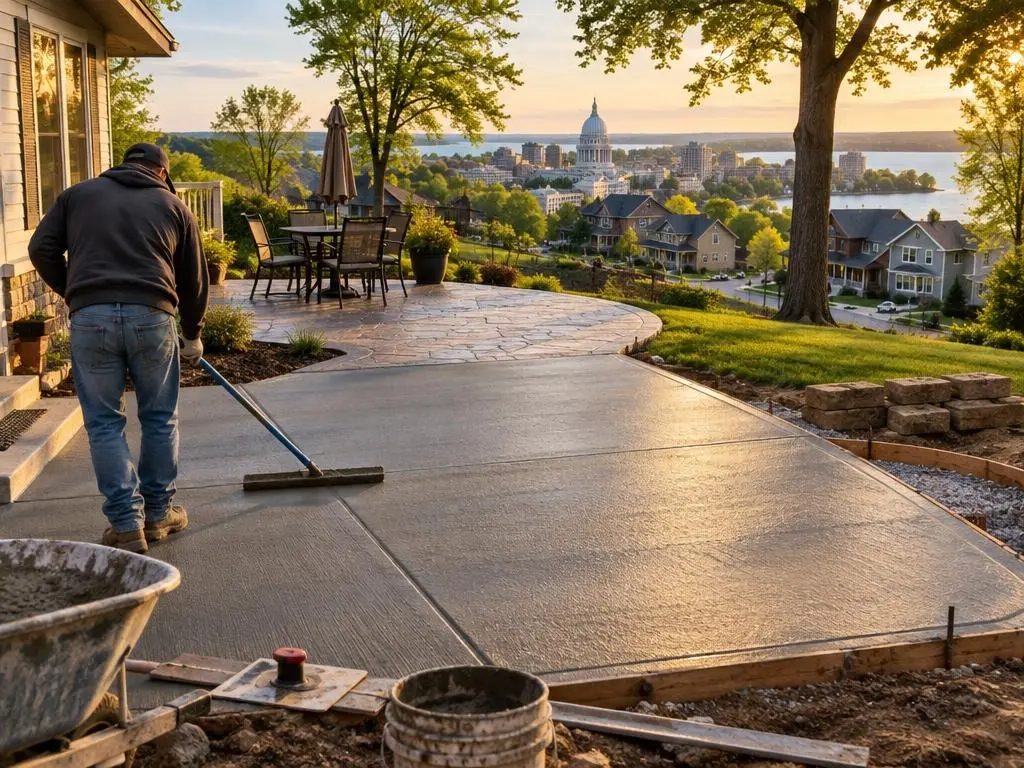
Our Concrete Services
Six kinds of residential concrete work, each planned for Madison freeze-thaw, plowing and de-icer use.
Concrete Driveways
Driveway tear-outs, replacements, widening and new aprons on a drained stone base, built for plows, salt and Madison freeze-thaw.
Learn more →Concrete Patios
Backyard patios in broom, colored or exposed-aggregate finishes, sized for how you use the yard and pitched to shed water.
Learn more →Stamped Concrete
Stone, slate and brick patterns pressed into fresh concrete for patios, walks and driveway borders, with color and sealer chosen for cold winters.
Learn more →Sidewalks & Steps
Front walks, side paths, stoops and poured steps with landings, plus help with City of Madison sidewalk program notices.
Learn more →Concrete Leveling & Lifting
Mudjacking and foam lifting to raise sunken driveway panels, walks, patios and stoops when the slab itself is still sound.
Learn more →Concrete Repair & Resurfacing
Crack sealing, resurfacing over flaking concrete and spot replacement of failed panels, with an honest call on repair versus replace.
Learn more →Get a Free Concrete Estimate in Madison
We measure on site and price the work in writing, in Madison and the surrounding Dane County towns.